The first hour after an enquiry, and the follow-up nobody owns
When researchers pose as buyers and send enquiries to real businesses, one finding keeps coming back, and it is more basic than speed: a large share of enquiries get no reply at all.
What the test enquiries found
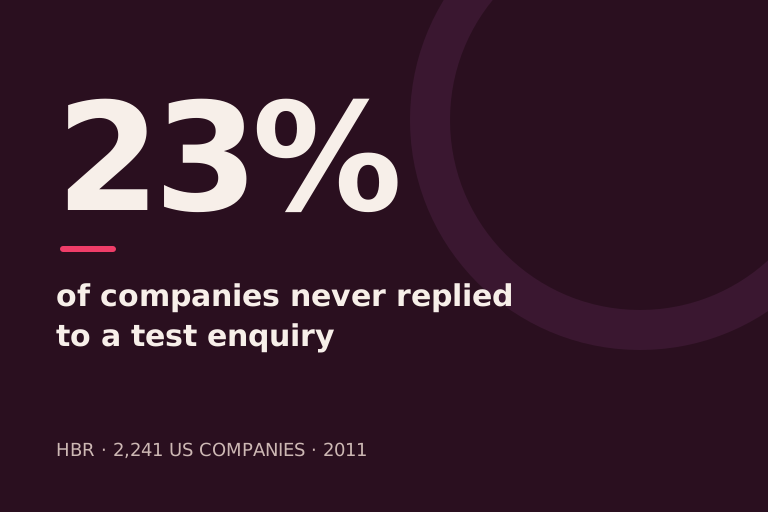
- Harvard Business Review's audit of 2,241 US companies found that 37% replied within an hour, 24% took more than a day and 23% never replied. Among those that did reply, the average wait was 42 hours.
- InsideSales sent test leads to 9,538 US companies for its 2014 report. 47% never responded, and the median number of attempts to make contact was one.
- Closer to home, Survey Booker sent an enquiry to 132 UK surveying firms. Nearly half replied within the hour, but 15.9% never replied, and only one firm followed up after its first reply.
Two of those studies come from vendors selling a fix for the problem, and the samples are uneven. The pattern holds across all three anyway: the enquiry arrives, and nobody in particular is responsible for what happens next.
Speed matters, within reason
The same HBR study looked at 1.25 million leads across 42 firms. Those that tried to make contact within an hour were nearly seven times as likely to have a meaningful conversation with a decision maker as those that tried even an hour later. It is US data from 2011 and it shows a correlation rather than proof, but the direction is hard to argue with.
You will also see the claim that calling within five minutes makes you 100 times more likely to reach someone. That figure comes from a 2007 vendor presentation built on phone data from six companies. A later study of around 45 million leads by VanillaSoft and the University of Ottawa's Telfer School found the best odds of first contact came between 10 and 60 minutes after the enquiry. Within the hour is a sensible target. Within five minutes is a nice extra.
An enquiry is usually yours to lose
6sense's 2025 survey of more than 4,000 B2B buyers, a sample that leans towards technology buyers, found that 94% of buying groups had ranked their preferred vendors before first contact, and bought from that favourite 77% of the time. By the time someone fills in your form, there is a fair chance you are already the one they want. Silence is the easiest way to lose them.
Nobody knows the magic number of follow-ups
The popular figures about how many follow-ups a sale takes do not hold up well. One of the best known, that most sales happen between the fifth and twelfth contact, goes back to a 1942 survey of fewer than 40 salespeople, according to SMEI. The VanillaSoft study put the average at 5.7 attempts for a positive outcome in B2B, but that is one vendor's preliminary figure.
A better number is your own. Take your last 20 clients and count the touches between their first enquiry and their yes. That tells you how long your follow-up needs to run.
Give every enquiry an owner
- A reply within the hour, every time. An acknowledgement that answers the question they asked and offers a time to talk, sent whether or not anyone is at a desk.
- A named owner and a dated next step. Every enquiry assigned the moment it lands, with the next action set for a date, so nothing waits on someone remembering.
- Follow-up that runs to your own number. A sequence that keeps going until the person replies, says no, or reaches the count your own wins suggest, and then stops.
- A weekly view of what is open. Which enquiries are waiting, on whom, and for how long.
The conversation itself stays with you. The system just makes sure every enquiry gets one.
If you want to see how enquiries are handled in your own business, the 10-Hour Audit can map it alongside the rest of your week.