The hours a small agency never bills
Ask a small agency owner where the margin went and the answer is rarely the creative work. It is the hours around it: building the monthly report, chasing a client for the brief they promised last Tuesday, chasing last month's invoice, and saying yes to the extra round of changes nobody priced.
The 2025 and 2026 agency surveys put numbers on each of those. None of them is a perfect sample, so I have said who was asked next to every figure.
Reporting: under an hour, or most of a week
In AgencyAnalytics' 2026 agency benchmarks, 73% of agencies using its tool build a client report in under an hour. That is a vendor measuring its own customers, so read it as what a largely automated report looks like.
At the other end, Fluent studied 104 agencies of up to 50 staff, counted every step from pulling the data to the final review, and found 20 to 30 hours per client per month. In 78% of them, at least three people touched each report before it went out. Also a vendor, also a small sample, but the gap is what matters: the same deliverable can cost an hour or most of a week, depending on how much of it a person assembles by hand.
Chasing clients for what they owe you
Function Point asked creative agencies what holds their productivity back most. 55% said clients not providing information on time, well ahead of scope creep at 31%.
Then there is the money. In Ignition's survey of 273 US agencies, 71% said at least one invoice in four is paid late, and 84% spend somewhere between three and ten or more hours a month chasing payment.
Scope creep nobody invoices
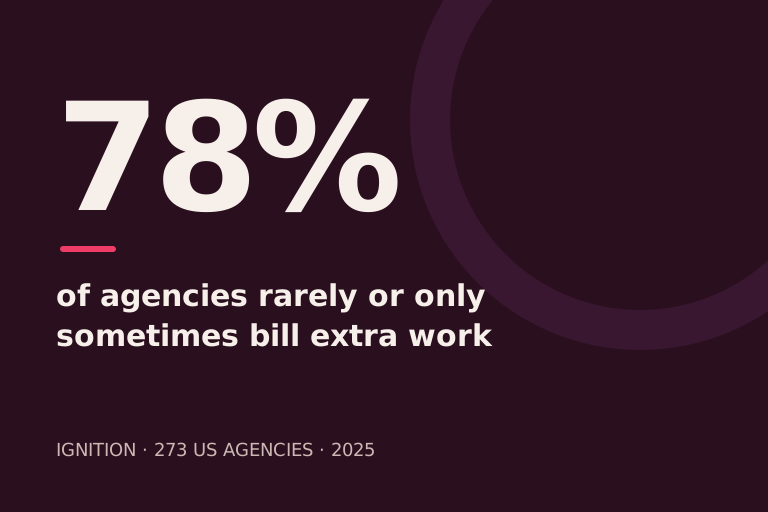
The same Ignition survey found that 57% of agencies lose $1,000 to $5,000 a month to unbilled work, and 30% lose more than $5,000. Most of it is never charged for: 78% rarely or only sometimes bill out-of-scope requests. It tends to arrive in small pieces, such as a quick extra version, one more channel in the report or a call that runs over, which is exactly why nobody stops to price it.
Why it matters more in a small agency
Promethean Research's 2026 study of digital agencies, mostly in the US, found that studios with fewer than ten staff averaged 19% net margins in 2025, against 8% for agencies of 50 or more. Small is already the efficient shape. What wears it down is the owner, or the one account manager, spending the week on work that is necessary but never billed.
What a system can take, and what stays with you
- The report. Pulling the numbers, building the charts and drafting the commentary for a person to check. Reporting has now overtaken content as the area where agencies say AI has helped most, named by 42% in the AgencyAnalytics survey.
- The information chase. A sequence that asks for the brief, the assets or the sign-off, nudges on a schedule, and only tells you when someone has gone quiet for too long.
- The invoice chase. Polite, consistent reminders that go out on day one, day seven and day fourteen without anyone having to remember.
- The scope log. Every extra request noted against the retainer as it arrives, so the conversation about charging for it starts from a written list.
A system cannot decide what to charge, or how to tell a good client that the extra round costs extra. Those conversations stay with you. The point is that you have the hours for them, and for the work clients actually pay for.
If you want to see where your own week goes, that is the first thing the 10-Hour Audit maps.