MTD for Income Tax: why 2027 is the harder year for small practices
The first quarter of Making Tax Digital for Income Tax has been and gone. HMRC says more than 436,000 sole traders and landlords sent their first quarterly update, from an estimated 864,000 in the first wave. For a lot of small practices the summer was harder than expected, and the bigger wave has not started yet.
Where it stands on 15 October 2026
- Qualifying income over £50,000: in MTD since 6 April 2026. About 864,000 people.
- Over £30,000: from 6 April 2027. About 1,077,000 people.
- Over £20,000: from 6 April 2028. About 975,000 people.
Those are HMRC's own population estimates. Quarterly updates are due on 7 August, 7 November, 7 February and 7 May, which puts the third-quarter deadline one week after the 31 January Self Assessment deadline. The penalty soft landing covers 2026 to 2027 only. After that, each missed quarter earns a point, and four points mean a £200 penalty.
One caution. ICAEW has asked the government to consider delaying the £30,000 cohort, and the Autumn Budget lands on 28 October. HMRC's latest guidance still says April 2027. I will update this piece if that changes.
Why 2027 is the harder year for a practice
HMRC's statistics show that 75% of the first wave use an agent, against 63% of the second. That sounds like less work for practices until you multiply it out: roughly 648,000 agent clients in the first wave and roughly 679,000 in the second. That is my arithmetic from HMRC's figures, not theirs. The second wave is also less digital, with 49% filing Self Assessment through software against 63% of the first. And they arrive without the penalty easement.
The bottleneck was getting records from clients
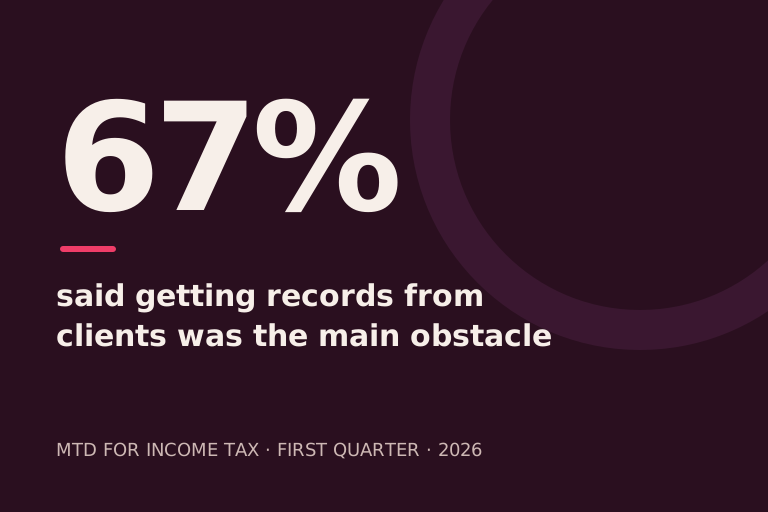
When the Accountants Therapy community surveyed 142 practitioners after the first deadline, as reported by ICAEW, the biggest obstacle was getting information from clients (67%), ahead of practice capacity (46%). Only about a third filed every client on time, and only 25% said their fees fully covered the time it took. As ICAEW's Lindsey Wicks put it, "every time you're making contact, that's time spent".
HMRC's own research with agents pointed the same way before launch: 86% expected to take on extra tasks to keep clients compliant. And a Wolters Kluwer survey this spring found the share of firms naming time and resource constraints had risen from 22% to 33%, which it read as capacity becoming the limiting factor.
What to sort out before April 2027
- The records chase. Four times a year, for every client, someone has to ask for the records, nudge, and nudge again. That sequence can run by itself, with a person stepping in only when a client goes quiet.
- Onboarding the second wave. Engagement letters, authorisation, software set-up and the first request for records follow the same steps every time. Doing them by hand for a few hundred new MTD clients is where the hours go.
- Knowing who is behind. One view of which clients have sent what for the quarter, so the week before 7 February is not spent finding out.
- The fee conversation. If only a quarter of practices recovered their time, the price needs to reflect four touches a year. That decision is yours, and it is easier to make with real hours in front of you.
None of this replaces the judgement in the work. It takes away the chasing around it, which the first quarter showed to be the real constraint.
If you want to see what that would look like in your own practice, the 10-Hour Audit starts by mapping where the hours go.